XERF Before and After: Results Timeline, Photos, Benefits and What to Expect

Table of Contents
Medically Reviewed by Dr. Priya Kumari,
10+ Exp | GP Dermatology | MBBS + DHA
Quick Answer: What Do XERF Before-and-After Results Look Like?
XERF before and after photos may show improvement in the appearance of skin firmness, mild facial laxity, jawline definition, and certain wrinkles. The XERF procedure utilizes dual-frequency monopolar radiofrequency energy to heat targeted tissues. Improvement may be gradual and individual differences in improvement may occur.
Research studies published have shown improvement one to three months after treatment; however, the studies done to date are small in number and do not offer any guarantee of improvement for every individual. Individual baseline skin quality, facial anatomy, treatment parameters, and technique can affect the result.
If you are looking for XERF skin tightening treatment in Dubai, please make sure to compare photographs taken under similar conditions and what result you may expect with your concern.
What Can XERF Before and After Photographs Show?
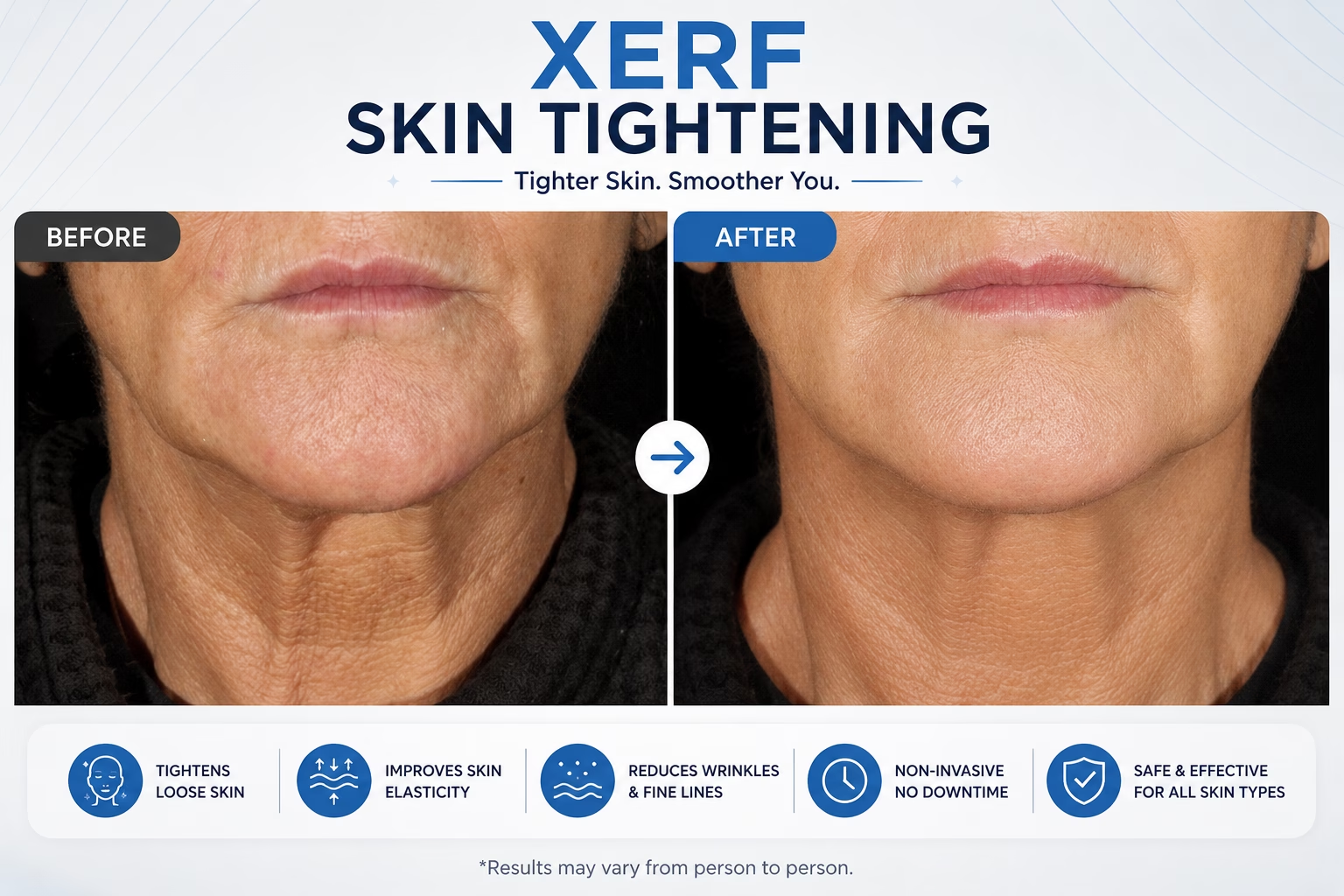
XERF before and after photographs aim to show visible changes after a non-surgical radiofrequency skin tightening treatment. For each individual and depending on the area treated, XERF before and after photos may show changes in skin firmness, the appearance of mild laxity, lower face contour, or certain wrinkles.
However, not everyone may see the same changes. Also, a photograph cannot show all aspects of a treatment result such as comfort, temporary side effects or how long the improvement lasts.
Places where improvement can be assessed:
- Jawline: The change in the definition of the lower face.
- Lower cheeks: Improvement in the appearance of mild skin laxity.
- Neck: The improvement of the appearance of the selected laxity or wrinkles, if the neck is an appropriate area to treat.
- Fine lines: Improvement in the appearance of the selected fine lines.
- The overall appearance of skin: Whether it looks firmer and smoother.
These are the potential improvements, that could be assessed, but they are not guaranteed. XERF is not an alternative to a surgical treatment if there is a lot of skin surplus and cannot fix all reasons of facial aging.
Why some pictures before and after procedures look more impressive than others?
The level of the visual difference depends on the initial condition of the person and the protocol of the procedure as well as the time difference between pictures.
For instance, the person who had only mild laxity might show small improvement, and another person’s pictures will have more obvious changes. In addition, lighting, camera angle, the position of the person, his expression, or other factors can influence the impression.
Thus, the good before and after picture should show only the actual result.
Results Time Line for XERF Procedures: What’s the Time Frame?
The results from the XERF procedure should be considered based on a time-based evaluation, rather than solely on the way the skin appears right after the procedure. Appearance, how things change over a number of weeks, and how durable results might last are different issues.
The below time line serves as an approximate guide, not as a specific time for your results to occur.
Time after treatment | What to understand |
Immediately after treatment | Temporary redness, warmth or swelling may affect the appearance of the skin. An immediate visual change does not establish the final result. |
First few weeks | Early changes may become noticeable, but results vary and can be subtle. |
Around 1 month | A useful time to review early progress, ideally with photographs taken under consistent conditions. |
Around 3 months | A later assessment can help evaluate how the appearance has changed compared with baseline. |
Beyond 3 months | Longer-term durability should be assessed using follow-up evidence and individual clinical review; it should not be assumed from short-term photographs alone. |
Important Note: This table compares the technologies, not the guaranteed results. Any differences in energy delivery cannot be considered as evidence of more effective lifting, longer-lasting effects or fewer side effects.
Must Read: XERF vs Ultherapy: Which is better skin tightening treatment for me?
What does the publish XERF research say?
One prospective multicentre study published in Cureus in 2026 involved 39 participants who underwent two XERF treatment sessions. Outcomes were measured at 30 and 90 days’ post-treatment by standardized photographs, physician assessment and patient satisfaction scale. Improvement in aesthetic outcomes according to physicians’ assessments was reported at both follow-ups.
A different retrospective study published in Lasers in Medical Science in August 2026 involved 16 women who underwent a single XERF treatment. Assessment was conducted on photographs, facial measurements and skin quality assessments at one and three months’ post-treatment. Changes in selected parameters of facial laxity and skin quality were reported.
These are promising results, however there are limitations. The sample sizes were small, and the retrospective study lacked a control group. The results do not confirm that everyone will see improvement, that XERF is better than another device and how long the results will last.
Sources:
XERF Before and After: What Results Should You Expect by Area?
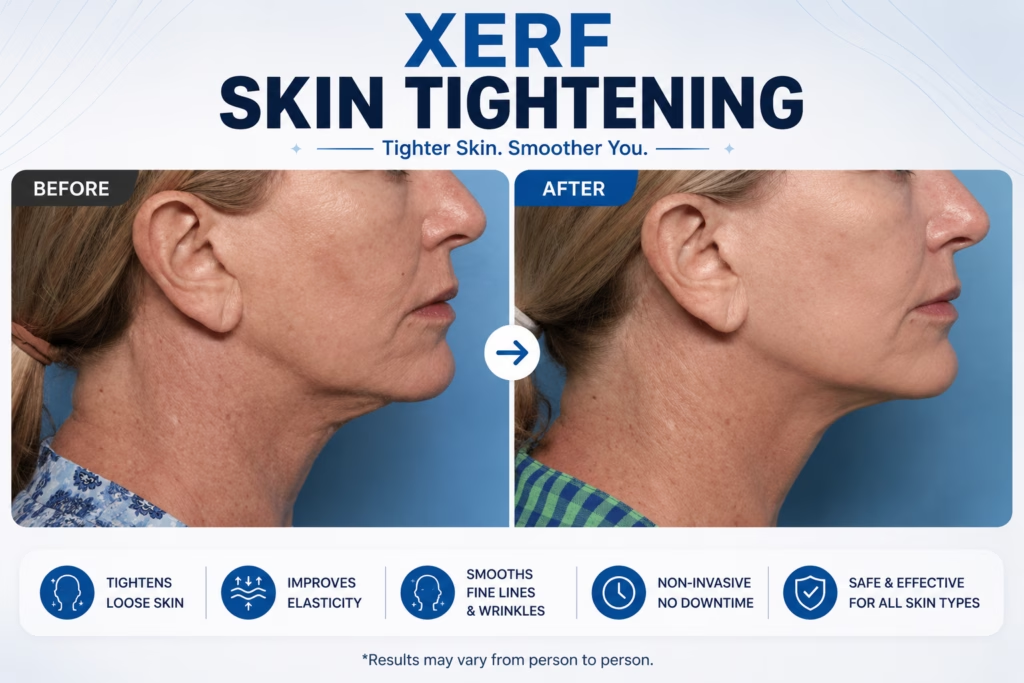
The expected result will depend on what area is being treated. For example, treatment aimed at improving skin firmness cannot be expected to resolve all issues caused by aging.
1. XERF before and after in the jawline
One of the reasons why people opt for XERF is that the jawline appears less defined than before. It can be due to skin laxity, redistribution of facial fat or some other reason.
Should mild skin laxity be one of the causes of your concern, then the procedure aimed at skin tightening may be worth considering. However, it cannot be expected to remove excess skin or solve all problems causing undefined jawline.
When analyzing photos, pay attention to a similar position of your head, lighting and camera angle. Even a slight change in the chin position may alter your jawline considerably.
2. XERF before and after for jowls
Jowls could appear due to skin and underlying tissue aging. The degree of skin laxity, the position of fat deposits and the structure of tissues in the face could affect jowl appearance.
XERF could be used in carefully selected cases when skin laxity is one of the concerns. XERF should never be offered as a surefire way to get rid of jowls.
In case of well-developed jowls or jowls that have more to do with deeper tissue sagging, the outcome of a non-surgical procedure might not be as significant. A consultation will help you understand how the treatment could help and what it will not affect.
3. XERF before and after for the neck
Changes in the neck could include skin laxity, fine lines, deeper tissues and muscle definition. They all require different solutions.
Ask if your neck is a good candidate for treatment according to the current indications for the use of the device and if the treatment plan addresses your problem. Do not assume that the results achieved on the lower face will be the same for the neck.
4. XERF before and after for wrinkles and skin texture
There are some studies done on the effects of XERF that have looked at the reduction in wrinkle severity as well as measures of skin quality. It depends on the particular type of line or texture problem being addressed.
Lines created primarily due to muscle activity are different from lines formed because of laxity or poor skin texture. XERF cannot be considered a treatment for all types of wrinkles.
If you have issues with pigmentation, acne scarring or uneven skin tone, you may want to ask if there is a better way to address these specific problems.
5. XERF before and after for a thin face
Individuals with thin faces or who have experienced loss of facial volume should talk about this issue before undergoing treatment.
The tightening effect and the restoration of lost facial volume are not the same thing. Prior to recommending any energy based treatment, a professional need to take into account the facial structure and the desired outcome.
Ask how your unique facial structure will be taken into consideration.
Also Read: XERF Reviews by Patients: Is XERF Worth it?
How to Interpret XERF Photos Before and After Treatment Properly
Photos can assist you in understanding potential results, but only if you have the knowledge about how and when those pictures were taken.
Use the following list when evaluating the photos.
- Evaluate the time between the two photos.
A photo taken right after the procedure would not answer the same question as the one taken three months later. It is important to establish the exact follow-up period.
- Compare the angles.
Make sure that the faces are photographed from the same angle. An elevated chin, turned head, or varied camera height might change the picture of the jaw line and neck.
- Evaluate the lighting.
Overhead lighting might accentuate the shadows and wrinkles, whereas frontal soft lighting would diminish their effect.
- Pay attention to the expression.
A relaxed face needs to be compared with another relaxed face. The action of smiling, tensed jaw muscles, or lifted eyebrows might change the result significantly.
- Determine the treatment.
Find out which area was treated, the number of sessions, and additional procedures done within the same period.
- Determine if the photos reflect common results.
A single impressive result doesn’t tell you about the frequency of such results.
- Look for image manipulation.
Photos should not be edited in order to achieve a more youthful look. If the clinic can’t explain how the photos were taken, then don’t take the comparison seriously.
- Determine what the photos won’t show you.
Photos won’t tell you how comfortable the procedure is, if there are any side effects and if the result lasts long term.
Must Read: How to Choose Skin TIghtening Clinic in UAE? Expert Insights
What information should a reputable clinic’s photo gallery contain?
The gallery should contain information about the procedure, the part that was treated and the time that passed between the two photos. It should also say if any additional procedures were done and if the photos are used with patient’s consent.
When you look at XERF before and after photos at a clinic in Dubai, request this information instead of choosing the treatment based on the most impressive image.
Why your XERF may differ from another person’s Results?
Two people can undergo the same treatment and have different outcomes. This is a typical occurrence in the field of cosmetic surgery.
These factors may affect the result:
- From the beginning, the laxity of the skin is not a severe problem and a mild laxity is not the same.
- Facial anatomy: Different people have different thicknesses of skin, different distributions of fat, and different supporting structures.
- Treatment settings and technique: The nature of treatment and the method of delivery is important.
- The area of treatment: The lower face, the jaw line and the neck have various anatomical features.
- The condition of the skin and age can affect the way the skin looks and reacts to treatment.
- Previous procedures: Other energy-based treatments, injectable or surgery may impact treatment planning.
- Outcome measurement: A subtle change can be better detected in a standardized photo than in a handheld mirror reflection.
At Glow Aesthetic during the consultation our XERF specialist should let you know how these are relevant to you. Don’t use someone else’s answer to guess what your answer might be.
Does XERF give instant results?
There may be a change in skin appearance noticed early on after treatment for some individuals. But a change now doesn’t determine the amount of lasting gains that will be made.
The skin can look temporarily different, too, due to redness, swelling or other short-term reactions. The effects are not a stable result.
A better evaluation is obtained by comparing the baseline photographs to photos taken after a suitable time period. Inquire of the practitioner about the time of next follow up examination and the need for further treatment.
How many XERF Sessions until the results are seen?
It is not possible to say how many sessions would be suitable for every patient. This is dependent on the device protocol, the clinical evaluation, the treatment area and on the expected outcome.
The prospective multicentre study in 2026 was undertaken by all 39 participants, with two sessions approximately 4 weeks apart. The 16 women in the separate retrospective study were evaluated following a single session.
The nature and intensity of these studies varied and cannot be interpreted as evidence that everyone should have two or more sessions. Our practitioner should tell you about the plan if treatment is to be carried out and why.
Avoid buying a package just for a desired transformation. Discuss the suggested number of sessions and the ways in which progress will be tracked.
Conditional side effects and risks for XERF Before and After
XERF is a non-invasive technique, but it is not risk free.
The 2026 studies experienced mostly mild, short-term reactions such as redness and swelling, and no long-term reactions were reported in the study groups. Uncommon complications that may arise from the small studies cannot be ruled out, nor can they establish the risk for every patient.
Discuss with the treating clinician any possible reactions and precautions. Inquire about potential short-term reactions, the directions for the device and any medical conditions that may be relevant, as well as what should be done if side effects continue or get worse.
If you have a thin face, if you’ve had issues with volume loss, if you’ve ever had a complication from energy based facial treatments, or if you have a medical problem which could make you unsuitable, let your consultant know.
If pain is severe or increasing, or if any other unusual symptom occurs after treatment, seek medical advice as soon as possible.
Also Read: XERF Side Effects and Safety: Can XERF cause face fat loss?
What Should You Do Prior and after XERF Treatment?
Instructions for your clinic must correspond to the device, treatment area and your medical situation.
Before treatment
- Discuss your medical history, medication and previous aesthetic treatments with the practitioner.
- State your primary concern and the amount of change you hope for.
- Discuss the areas that will be addressed and what is realistic.
- Discuss any possible side effects, alternatives and the overall cost.
- Ask if there are standard baseline photos to take.
- Follow the pre-treatment instructions given to you by the clinic.
After treatment
- Follow instructions for aftercare given by your treating clinician.
- Inquire about any skin care products or activities that you should temporarily avoid, if any.
- Do not add more energy-based procedure, without clinical guidance.
- If there is a reaction that is unexpected, increasing or not improving according to the advice of the clinic, contact the clinic.
- Follow recommended follow-up to confirm that the result has been achieved.
There is no single aftercare plan that can be used in place of your own aftercare program.
A Clinical Perspective: How to pick the right XERF for your skin.
In making comparisons between the “before” and “after” photos of a patient on the XERF site, it is critical that you ask yourself whether the patient whose photo you are comparing had a concern like yours.
If this article is reviewed by and approved by Dr. Priya Kumari 10+ Years of Exp, GP with Dermatology at Glow Aesthetics Dermatology Clinic, then she can be identified as the medical reviewer. The assessment should include skin laxity, facial volume, area of treatment and treatment goals before a recommendation is made.
It is also important that a suitable consultation should include an explanation of the limitations of non-surgical tightening, the risks involved, options and evaluation of the success of the treatment. It is not about whether you’ll look like a chosen photo, but about determining if the treatment is suitable.
What Questions Should be asking in First XERF Treatment to Practitioner
If you are thinking of taking up XERF in Dubai, take the consultation to understand the proposed treatment, not just from the images.
Ask these questions:
- Am I dealing with a primary skin loss problem due to the skin being too loose, to low volume of skin, or for another reason?
- Do I have the ability to work with others?
- Where will they be treated and why?
- How much improvement is possible in my situation?
- How many sessions is proposed and why?
- What are the side effects and complications?
- When might my result need to be checked?
- What is the total expense (including any recommended continuation costs)?
- Are photographs available (consented and unedited) and with an explicit follow-up period?
- If you are not likely to get what you want from XERF, what alternatives do you have to consider?
Glow Aesthetics has clinics in Dubai and at Sahara Center in Sharjah. You can find out about the services offered by the clinic, and book an appointment to discuss whether they are suitable, what to expect from the treatment, and any current treatment fees.
Also Read: XERF Treatment Cost in Dubai: What Affects the Price?
Conclusion
Pre- and post-XERF photos may be used to demonstrate possible changes in skin firmness and certain concerns relating to laxity in the face. Nevertheless, photos need to be put into context: timing since the procedure, number of treatments done, initial state of the patient, and how photos were taken are crucial.
Early clinical evidence of short-term efficacy is available in publications as of 2026, but not enough for any guaranteed outcome or long-term durability. The best thing to do would be to consult your concern, assess possible benefits and drawbacks and set up realistic follow-ups.
In case you want to consider XERF treatment with Glow Aesthetics in Dubai, please book a consultation to discuss indications, benefits, drawbacks and cost.
References
- Weiss RA, et al. Clinical Outcomes Following Dual-Frequency Noninvasive Monopolar Radiofrequency Treatment for Facial Laxity and Lower Face Lifting: A Prospective Multicenter Study. Cureus. 2026. Read the study.
- Erlich G, Dahan E, Wolf Y. Objective and subjective retrospective evaluation of XERF, a novel single-shot dual-frequency non-invasive monopolar radiofrequency. Lasers in Medical Science. 2026. Read the study.
- Cynosure Lutronic. XERF Structural Skin Tightening. Manufacturer information and example before-and-after images. View the manufacturer’s page.
This article is for general educational purposes and does not replace a consultation with a qualified healthcare professional. Treatment suitability, expected results and risks must be assessed individually.
Medically Reviewed Skincare Advice
 12+ Years Experience
5,000+ Patients Treated
Dermatology & Aesthetic Skin Therapist
 12+ Years Experience
Get Free Consultation Now!
+971 - 56 548 7001
This can vary from one individual to another. While some people may see early results, a more valuable comparison would be between photographs taken before treatment and those taken in subsequent weeks and months. Studies have measured results at 30 and 90 days, but this does not indicate how long it will take for you.
XERF before and after photos can reveal alterations in skin texture and tightness, mild laxity, selective wrinkles or lower face contour. The type of change seen will depend on the patient’s initial state and treatment. These photos must be taken in similar lighting conditions and cannot be used as a guarantee of your result.
A small number of patients may see results after one treatment, but there is no guarantee. In a retrospective study conducted in 2026 on 16 women who received one XERF treatment, changes were seen in selective facial measurements and skin quality.
A prospective multicentre study of 39 patients revealed improvement in aesthetic results as rated by clinicians 30 and 90 days following two treatments. A retrospective study of 16 women showed changes in certain parameters after one treatment. The above constitute initial data, but further research is required.
XERF could be used in some cases where skin laxity is causing jawline deficiency. But the jawline is influenced by fat deposits in the face as well as deep tissues. A practitioner must establish the cause prior to recommending a treatment.
Jowls should not be eliminated using XERF. It could be used in some cases where skin laxity is present. But a more pronounced descent or excess skin would require a different solution.
There is no conclusive proof of permanent results. Skin goes through changes with aging, and there have been short follow-up durations in the existing XERF studies. Ask your practitioner what is known about permanence and do not buy into the claim that the results will be permanent for so many years.
The modification of facial contour is dependent on anatomy, settings of the treatment, and the method itself. If you have a thin face or facial volume loss, inform the practitioner before the treatment begins. Find out how your practitioner will determine your facial volume and whether another technique will serve you better.
Any one photograph cannot prove that a certain treatment is effective for everybody. While photographs may serve as an example of an individual case, light, camera angle, facial expression, other treatments, and duration of follow-up affect the comparison.
Find the same person photographed from similar angles, under similar lighting and with similar facial expression. Find out when the follow-up picture was taken, what areas were treated and whether any other procedures were done. Choose consented pictures where the information regarding treatment is clearly indicated without retouching that distorts the result.
It is impossible to judge about suitability depending on the type of skin only. The practitioner has to examine your skin condition, your medical background, the area of treatment and any special considerations concerning the devices used. Ask whether this treatment suits you and what alternatives can be suggested.
The cost depends on the clinic, the area of treatment, the suggested treatment program and what is included. Ask for the latest quotation specifying what areas will be treated, how many sessions are required, consultations and follow-up. Don’t expect the price from another place to apply to your case.
HydraFacial for Acne: Does It Really Work? Dermatologist Guide + Real Results